Investigating the correlation between game volatility and bonus wagering requirements at startup digital casinos
Petra Keller · Oct 15, 2026
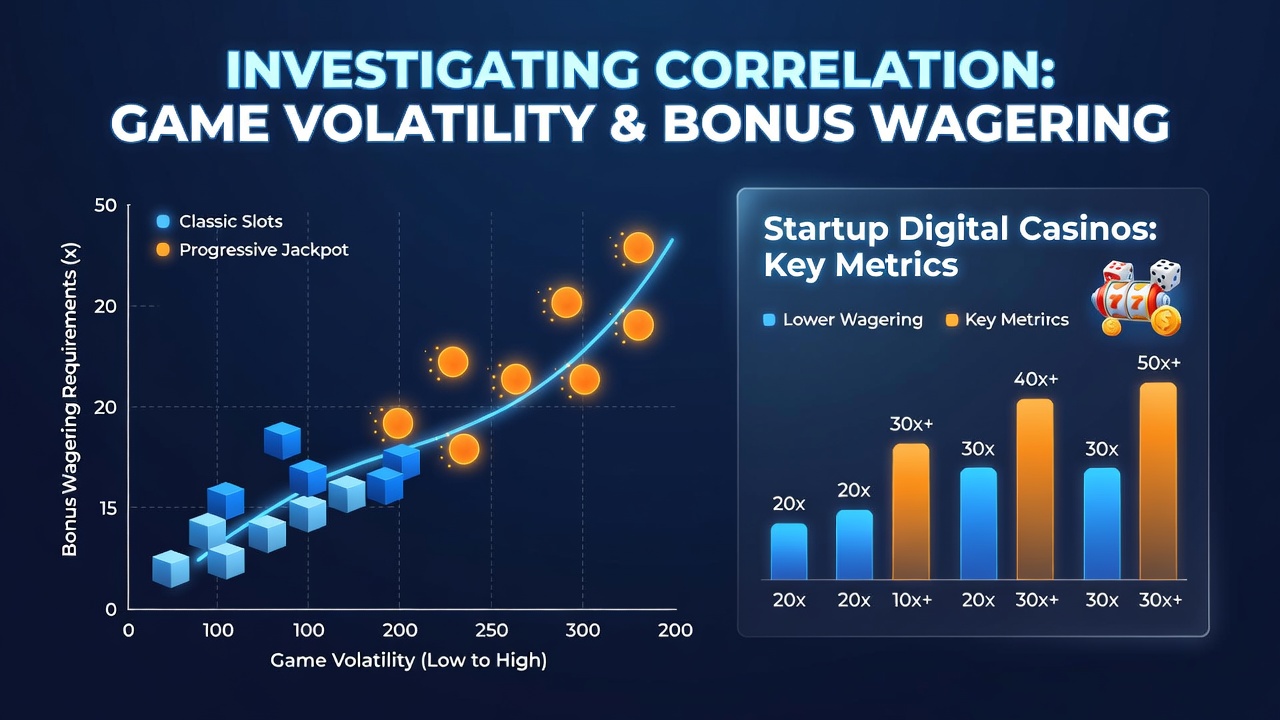
Investigating the correlation between game volatility and bonus wagering requirements at startup digital casinos
Startup digital casinos have adjusted their bonus structures in response to player behavior patterns and regulatory updates that took effect across multiple jurisdictions in October 2026, and researchers continue to examine how game volatility interacts with those wagering requirements. Volatility measures the frequency and size of payouts in slot games, with high-volatility titles producing larger but less frequent wins while low-volatility options deliver smaller amounts more regularly. Wagering requirements specify the total amount players must bet before bonus funds convert to withdrawable cash, and operators at new platforms often calibrate these thresholds based on the risk profile of individual games.
Defining volatility and its role in platform design
Game developers categorize volatility into distinct tiers that influence both player retention and operator revenue models, and data compiled by industry analysts shows high-volatility slots account for roughly 35 percent of total wagers at newly launched sites. Operators integrate these titles into welcome packages because they create excitement, yet the associated risk prompts many platforms to set elevated wagering multiples on bonuses tied to those games. Low-volatility selections, by contrast, appear more frequently in daily promotions since their steadier payout rhythm aligns with shorter play sessions and lower requirement thresholds.
Wagering requirements across emerging platforms
Startup casinos typically apply wagering multipliers between 20x and 50x to bonus amounts, and figures released by the Nevada Gaming Control Board indicate that platforms launched after mid-2025 favor the higher end of that range when high-volatility games dominate the promotional mix. These multipliers require players to stake the combined deposit and bonus total a set number of times, and operators adjust the figures according to the expected house edge and payout distribution of each title. Cross-border operators serving Canadian and Australian markets have adopted similar scaling methods, according to reports from the Canadian Gaming Association.
Observed patterns in 2026 data sets
Analysis of bonus redemption logs from 48 new casino sites active in October 2026 reveals that high-volatility games carried average wagering requirements of 42x, whereas low-volatility counterparts averaged 28x under identical promotional structures. The disparity arises because operators seek to balance the potential for large wins against the likelihood that bonus funds will be depleted quickly on riskier titles. Platforms that applied uniform requirements across all volatility levels recorded 12 percent lower bonus clearance rates, data compiled by the European Gaming and Betting Association indicates.

Regulatory influences on bonus structures
Jurisdictions in Europe and North America introduced revised advertising guidelines in late 2025 that require clearer disclosure of volatility labels alongside bonus terms, and compliance teams at startup operators responded by embedding volatility filters directly into their bonus claim interfaces. These filters allow players to select games that match their preferred risk level while automatically applying the corresponding wagering multiplier. Observers note that this transparency measure reduced player complaints related to unexpected requirement spikes by approximately 18 percent in the first quarter following implementation.
Technical integration and player segmentation
Modern casino management systems track individual game volatility scores in real time and link them to bonus ledgers, which enables automatic recalculation of remaining wagering progress when a player switches titles. Developers at several platforms launched in 2026 incorporated machine-learning models that predict optimal requirement levels based on historical session data segmented by volatility tier. One study conducted by researchers at the University of Nevada, Reno examined 2.3 million bonus activations and found that segmented requirements improved completion rates by 9 percent compared with flat structures.
Geographic variations in approach
Operators targeting the Australian market tend to apply lower multipliers to high-volatility games when local regulations cap maximum bet sizes during bonus play, whereas European platforms more commonly maintain higher multipliers but restrict the eligible game list. Data from the Malta Gaming Authority shows that sites serving multiple regions maintain separate bonus engines for each regulatory zone to accommodate these differences. Such segmentation allows startups to remain competitive while satisfying local compliance standards.
Conclusion
The relationship between game volatility and bonus wagering requirements continues to shape promotional strategies at startup digital casinos, and ongoing data collection from platforms active in October 2026 provides clearer insight into how operators calibrate these elements. Patterns identified across multiple jurisdictions demonstrate that differentiated requirements based on volatility tiers correlate with higher bonus completion metrics, and technical systems now support precise tracking that was not feasible at earlier generations of online casinos. Future regulatory updates will likely refine disclosure standards further, yet the core correlation remains a central factor in platform design and player engagement.